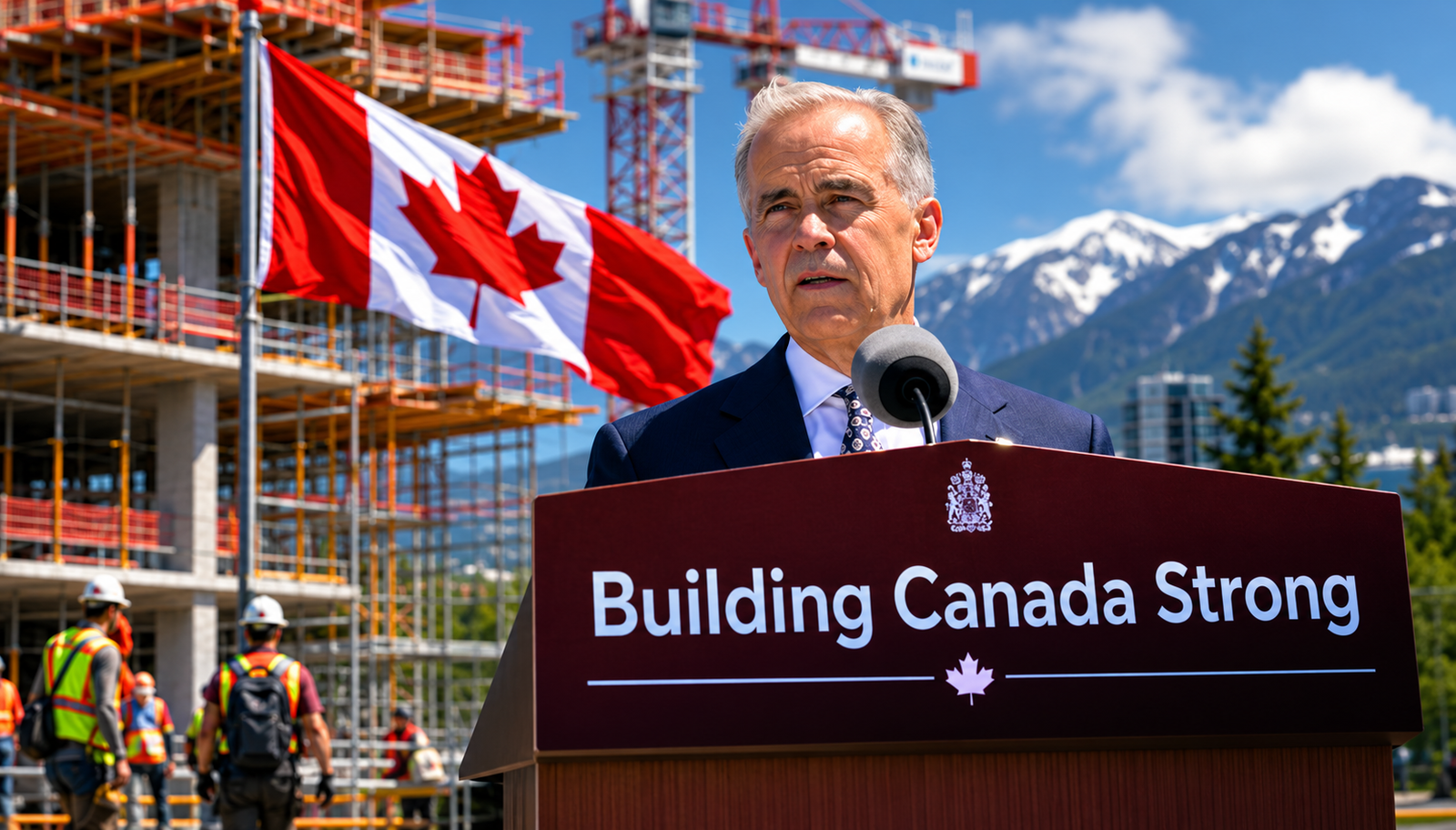
 Prime Minister Mark Carney and Premier David Eby were in Vancouver yesterday — June 18 — to announce a package of housing measures they are calling an effort to "unfreeze" BC's real estate market. The announcement was made in South Vancouver's River District, flanked by condo towers where two-bedroom units are selling for close to $1.1 million.Here is what was announced, what is still unclear, and what it means if you own or are buying on the North Shore.
What Was Actually Announced
Development Cost Charge Relief — $1.6 Billion Over 10 YearsThe headline number is $1.6 billion in federal funding, to be matched by the province, directed at lowering Development Cost Charges (DCCs) for multi-unit housing by up to 50 per cent — or as much as $40,000 per unit in designated "priority communities." The stated purpose is to expand housing-enabling infrastructure: water systems, wastewater systems, and local roads.This matters because DCCs have become a significant line item in new construction costs. A reduction of $40,000 per unit is not trivial in a market where development feasibility is already tight. Whether that saving reaches the buyer rather than staying with the developer is the question nobody could answer cleanly yesterday — more on that below.Vacant Condo Conversion — 2,200 UnitsThe federal government will work with BC Housing through Build Canada Homes to purchase and convert more than 2,200 vacant condo units in "priority growth areas" into affordable housing. Carney acknowledged the overhang of unsold condo inventory directly, describing units "that are unoccupied, that are going to sit there potentially for another couple of years." The financing model — buying at market and spreading costs at federal financing rates — will be detailed in the fall.Transit — $2.5 Billion Over 10 YearsAn additional $2.5 billion in federal transit funding was announced, on top of $852 million previously committed to TransLink and BC Transit. The Surrey-Langley SkyTrain extension is explicitly named. The broader mandate is new transit projects and increased frequency on high-traffic routes across the region.What Is Still Unclear
The honest answer is: quite a bit.Metro Vancouver Regional District chair Mike Hurley told Business in Vancouver he was not made aware of the DCC funding before the announcement and was unsure whether it would flow to the utility provider or directly compensate the regional district. His board had already cut DCCs by $387 million over three years in April at the request of developers — and subsequently wrote to senior governments asking to recover those costs. Hurley's position, which he held when he voted against the April cut, is that "growth should pay for growth." The new federal and provincial money shifts that cost to general taxation.The more fundamental question — whether developers will pass DCC savings on to buyers — was not answered. When BIV pressed Carney on this directly, he described the measure as a chance to "prove this model at scale" without committing to a mechanism that ensures savings flow through. Historically, development cost reductions in Metro Vancouver have not translated directly or proportionally into lower sale prices. Supply conditions, land costs, and margin expectations all factor into pricing decisions that developers make independently.The vacant condo conversion model is described as coming in "the fall." The details of how units are selected, what price the government pays, and what "affordable" means in the context of River District condo towers at $1.1 million for two bedrooms will determine whether this is a meaningful intervention or a rounding error.What It Means for the North Shore
For buyers: This announcement does not change what you can buy on the North Shore today or what it costs. The measures are structured around supply creation over a 10-year horizon, not demand stimulation in the near term. If you are actively looking for a home in North Vancouver right now, your decision should be based on current market conditions — not on the downstream effects of a federal infrastructure fund.That said, the transit commitment is worth watching. The North Shore's most persistent structural disadvantage relative to communities with SkyTrain access is transit. Any increase in TransLink frequency or capital investment that eventually improves North Shore connections has a real and lasting effect on relative desirability and value.For sellers: No immediate impact on pricing or buyer demand. The North Shore detached market is balanced at a $2,129,900 benchmark. The condo market at $784,500 is also balanced. Neither of those numbers moves because of a federal infrastructure announcement.For the presale market: This is where the DCC relief is most relevant. If the savings are passed through — and that is genuinely uncertain — the effect shows up first in new construction pricing. North Vancouver has 73 active presale and new construction developments underway right now. Any reduction in per-unit development costs that makes marginal projects viable could add supply over the next three to five years. That is a longer-term consideration, not a near-term catalyst.For the condo inventory overhang: Metro Vancouver does have a real and growing inventory of unsold new condos. If the federal government moves forward on purchasing and converting those units, it removes some of that supply from the market rather than letting it sit and pressure pricing. This is marginally positive for existing condo owners. How "priority growth areas" are defined will determine whether North Vancouver condos are included.The Bigger Picture
Yesterday's announcement is real money and a genuine federal commitment to housing as a policy priority. $1.6 billion in DCC relief and $2.5 billion in transit funding over a decade are not nothing.But the mechanisms are indirect, the timelines are long, and the critical question of whether savings reach buyers versus staying with developers is unresolved. The Metro Vancouver chair's comment — "the devil will be in the details" — is probably the most accurate summary of where things stand.We will continue tracking how these measures translate into actual project activity and pricing on the North Shore. If you have questions about what the current market looks like for your specific situation as a buyer or seller, reach out to the team directly.Wallace Green Real Estate Group — North Vancouver specialists. 604-377-4551 | 604-506-5364 | team@wallacegreen.ca